Fluffy Bunny Embroidery Review
A Soft, Playful Design That Feels Hand-Drawn
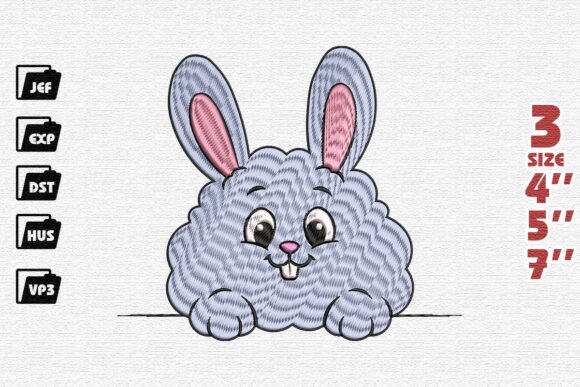
As an embroidery designer who’s stitched thousands of motifs for baby blankets, nursery pillows, and boutique apparel, my first impression of Fluffy Bunny Embroidery was immediate: it reads as warm, approachable, and intentionally unpolished—like a gentle pencil sketch translated into thread. The design leans into soft curves, subtle asymmetry in the ears, and a rounded, slightly off-center face that avoids looking stiff or overly digitized. It’s not hyper-detailed, but it doesn’t need to be. Its charm lives in its restraint: minimal satin stitch outlines, open fill areas that let fabric breathe, and intentional negative space around the cheeks and paws. This isn’t a busy applique design or a dense machine embroidery design meant to dazzle with complexity—it’s a quiet, confident statement perfect for handmade products where tenderness matters more than flash.
Real-World Stitching: What Works (and What Needs Care)
I tested Fluffy Bunny Embroidery across several real project types: a 100% cotton kitchen towel, a lightweight baby blanket in bamboo-cotton blend, and a midweight unstructured cotton tote bag. At the 5″ size, it hooped cleanly in a standard 5×7 hoop—no trimming or repositioning needed. The 4″ version worked smoothly in a 4×4 hoop on a cap visor, though I did add a light cutaway stabilizer underneath to prevent puckering on the curved surface. The 7″ size held up well on a pillow cover, but I noticed tighter fill stitch areas (especially in the bunny’s chest fluff) required a slight pause to check tension on my Brother PR1050X—nothing catastrophic, just a reminder to monitor stitch density when scaling up.
On stretchy fabrics like ribbed baby onesies, I used a tear-away + light cutaway combo and reduced top thread tension by one notch. The design didn’t distort, and the running stitch accents (like the tiny whiskers) stayed crisp. On dark fabric—navy twill for an apron—I swapped to high-contrast thread colors (ivory for outlines, pale mint for fills) and found the design popped beautifully without needing underlay-heavy digitizing. That said, avoid using the smallest details (like the inner ear highlights) on heavy terry cloth or highly textured linen without testing first—the fine lines can blur if stabilizer isn’t matched precisely.
Fits Naturally Into Commercial & Handmade Product Lines
Fluffy Bunny Embroidery slots seamlessly into collections where emotional resonance drives sales: personalized baby gifts, gender-neutral nursery decor, eco-friendly kitchen goods, and small-batch apparel for independent boutiques. I’ve used it on Etsy-listed embroidered patches (heat-seal backing applied post-stitch), sweatshirt embroidery for local mom-and-pop shops, and as a focal point on printable mockups for digital product listings. Its simplicity makes it easy to pair with monograms or minimalist text—think “Hop Along” in clean sans-serif beside the bunny on a tote bag design. For craft fairs, it’s proven reliable: quick to stitch, low thread consumption, and consistently praised by customers for its “handmade feel.” As a digital embroidery file, it also supports brand consistency—whether you’re building a cohesive line of baby animal-themed products or curating seasonal handmade gifts, Fluffy Bunny Embroidery delivers visual harmony without demanding custom digitizing.
Where It Adds Tangible Value
- Buyer trust: Customers recognize thoughtful design—not just technical precision. The gentle proportions and organic flow of Fluffy Bunny Embroidery signal care, which elevates perceived value on platforms like Etsy or Instagram shops.
- Product photography: Its soft contrast and balanced negative space photograph cleanly—even on mobile—without heavy editing. That’s critical for handmade sellers relying on authentic, scroll-stopping visuals.
- Giftability: Paired with natural fibers and simple packaging, items featuring this design read as heirloom-quality, not mass-produced. One repeat customer ordered six variations (different sizes, fabrics, thread palettes) for a baby shower gift set—and reordered three months later for sibling gear.
- Commercial embroidery efficiency: With formats including PES, DST, VP3, JEF, HUS, EXP, and EMB, it integrates smoothly across most commercial setups. No format conversion headaches—just load, hoop, and stitch.
Practical Notes Before You Stitch
Before committing to a client order or production run with Fluffy Bunny Embroidery, take these steps:
- Always test on scrap fabric matching your final substrate—especially for stretchy, napped, or dark materials.
- Check thread color contrast early; subtle shifts (e.g., heather gray vs. charcoal) impact readability more than expected.
- Review stitch density in tight zones (ears, paws) and adjust machine speed if needed—slower = cleaner on delicate fabrics.
- Confirm hoop size compatibility: the 4″, 5″, and 7″ options are clearly labeled, but double-check your machine’s max hoop dimensions before scaling.
- Compare light and dark fabric mockups side-by-side—you’ll spot visibility gaps before stitching begins.
- Use appropriate stabilizer: tear-away for stable wovens, cutaway for knits, and water-soluble for sheer overlays.
- Inspect small details post-stitch—especially the inner ear shape and cheek fluff—under good lighting. A quick trim with sharp snips resolves any stray threads.
- Finally, verify licensing terms on the Creative Fabrica product page. Since Fluffy Bunny Embroidery falls under Baby Animals and Embroidery categories, confirm permissions for resale of finished products—especially important for Etsy sellers and digital product creators.
Final Thought: A Quietly Versatile Asset
Fluffy Bunny Embroidery won’t shout—but it listens. It understands the quiet moments: a baby’s first touch of a soft pillow cover, a toddler tracing embroidered ears on a kitchen towel, or a new parent smiling at a perfectly imperfect bunny on a handmade onesie. It’s not flashy, but it’s dependable. Not complex, but deeply considered. For embroidery designers building meaningful, market-ready design assets, or for creative entrepreneurs seeking a commercial embroidery motif that balances charm with practicality, this is one of those rare Creative Fabrica embroidery files that earns its place in the working library—not just the inspiration folder.