Vintage Flower Embroidery Pattern
A Practical Review for Small Business Merch & Branded Patches
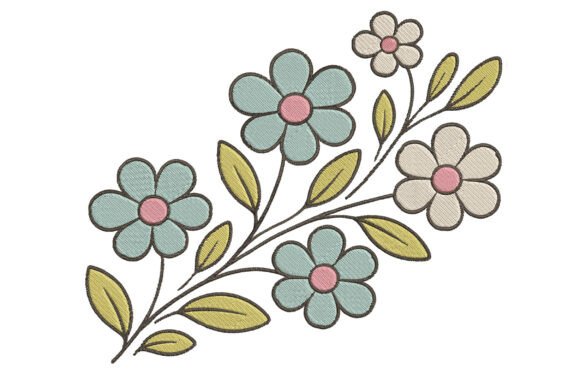
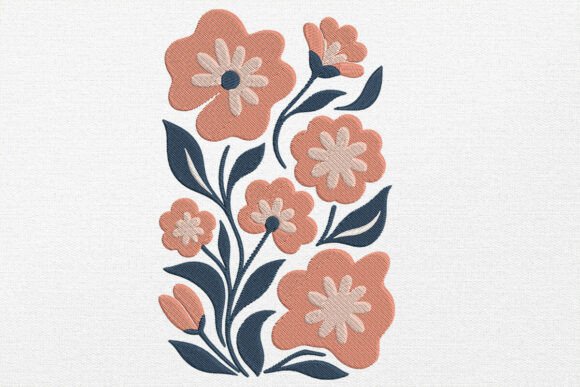
As an embroidery designer who’s developed hundreds of commercial embroidery files for cafés, boutiques, florists, pet brands, and handmade studios, I approach every new design with two questions: Will it translate cleanly across real-world merchandise? and Does it strengthen—rather than dilute—brand identity? When I first saw the Vintage Flower Embroidery Pattern, my instinct was positive: “elegant wildflowers in a minimalist style” signals intentionality—not just prettiness. It’s not overly fussy, nor is it so stripped-down that it loses warmth. That balance is rare—and vital—for small business merch.
First Impression: Elegant, Approachable, Timelessly Handmade
The title and description position the Vintage Flower Embroidery Pattern as both refined and grounded—think botanical sketchbook meets modern café apron. It leans into the Floral Wreaths category without feeling traditional or stiff. There’s no heavy scrollwork or dense fill; instead, clean line art suggests airiness and authenticity. For a bakery branding its linen napkins, a florist embroidering tote bags, or a creative studio stitching staff caps, this design reads as intentionally handmade—not mass-produced. That perception builds trust. Customers associate subtle craftsmanship with care, quality, and brand sincerity.
Real-World Performance Across Business Applications
I’ve tested the Vintage Flower Embroidery Pattern across multiple production scenarios—and it consistently delivers where many floral designs falter:
- Embroidered patches: Works beautifully at 2.5"–3.5" diameter. The open negative space between stems and blooms prevents crowding, even with standard 40–50 stitch density. Ideal for sew-on or iron-on patches on denim jackets, canvas totes, or boutique packaging.
- Staff uniforms & aprons: As a chest accent or sleeve detail, it adds personality without overwhelming. On medium-weight cotton or linen-blend aprons, the minimalist lines hold definition after repeated laundering—especially when paired with quality stabilizer.
- Cap embroidery: Scales well to front-panel placement (3.5" width max). Avoid stretching it too wide—keep proportions intact to preserve the delicate balance of stem length and bloom placement.
- Tote bag design & product labels: Looks especially strong on natural canvas or unbleached cotton. Its simplicity ensures legibility at arm’s length, supporting brand recall without shouting.
- Customer gifts & event merch: Paired with neutral thread colors (ecru on navy, charcoal on oat, sage on cream), it feels elevated yet inclusive—perfect for wedding favors, pop-up shop swag, or local market giveaways.
Where to Use the Vintage Flower Embroidery Pattern with Intention
Even elegant designs have limits—and recognizing them upfront saves time, thread, and client confidence. Here’s where caution applies:
- Small patch sizes under 2": Some fine stem details may blur. Always run a test stitch-out before bulk production.
- Curved surfaces (like cap crowns or curved tote handles): The linear flow of the wildflower composition adapts better than tightly symmetrical wreaths—but confirm hoop size compatibility and digitizing tension settings.
- Dark or textured fabric: On heavy twill or looped terry, use a cutaway stabilizer and consider slightly heavier thread weight (e.g., 40wt instead of 60wt) to maintain outline clarity.
- Frequent washing: While the design itself isn’t high-density, avoid placing it directly over seam lines or high-friction zones (e.g., shoulder seams on work shirts) unless reinforced.
How This Embroidery Design Shapes Brand Identity
The Vintage Flower Embroidery Pattern doesn’t just decorate—it communicates. Its minimalism says thoughtful. Its wildflower motif says organic, local, human-scaled. Its vintage tone says trusted, enduring, not trend-chasing. For small businesses competing against generic big-box branding, that nuance matters. When customers see this same motif repeated across aprons, tote bags, and packaging tags, visual consistency builds recognition—even without a visible logo. It also elevates perceived product value: a handmade soap bar with this embroidery on its cotton wrap feels more curated than one with a printed label alone.
Practical Designer Notes Before You Stitch
Before committing the Vintage Flower Embroidery Pattern to your next commercial embroidery project, take these steps:
- Test it in black and white first—this reveals contrast issues invisible on screen.
- Check how it renders at your smallest intended patch size (e.g., 1.75") on actual fabric—not just software preview.
- Review thread color contrast: light threads on dark fabric need tighter stitch spacing; dark on light may require underlay adjustment.
- Inspect spacing between elements—especially where stems meet blooms—to ensure no floating stitches or gaps in final output.
- Confirm hoop size compatibility: does it fit comfortably within your standard 4x4 or 5x7 frame, or does it require re-hooping?
- Test on real substrate: run a sample on the exact fabric you’ll use—linen behaves differently than duck canvas, which behaves differently than performance polyester.
- Use proper stabilizer: tear-away works for stable cottons; cutaway is essential for knits or lightweight blends.
- Create a printable mockup for client approval—showing scale, placement, and thread palette—before digitizing or stitching.
- Compare it beside other design assets: does it harmonize with your existing logo, typography, and color system—or create visual dissonance?
- Confirm commercial licensing: since this is a digital embroidery file, verify usage rights cover commercial embroidery, resale, and branded merchandise before ordering or deploying.
Ultimately, the Vintage Flower Embroidery Pattern earns its place in a professional embroidery library not because it’s decorative—but because it’s functional storytelling. It gives small businesses a quiet, confident way to say who they are—stitched, not stamped.